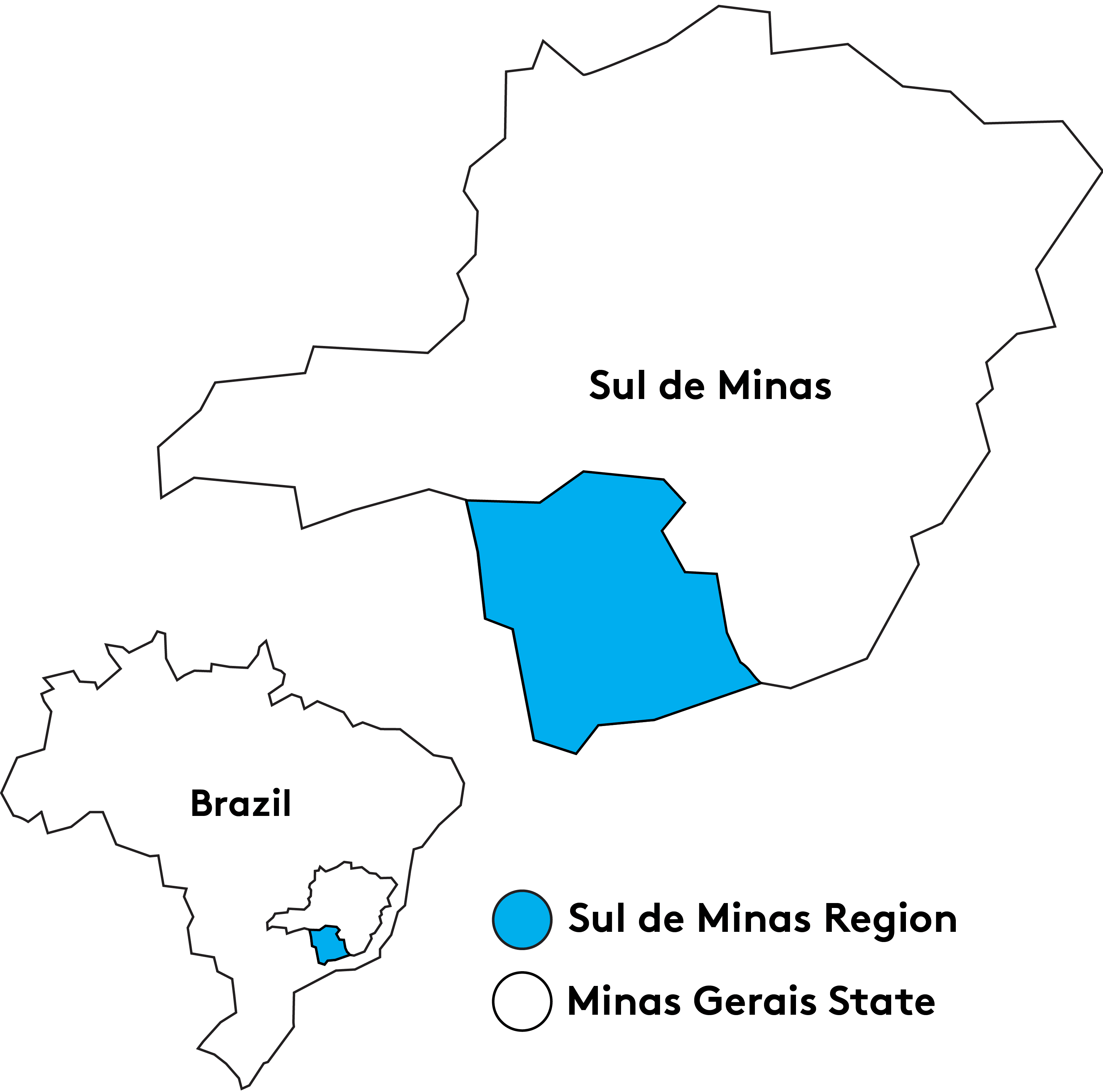
Located in the Sul de Minas region of Brazil, Sítio Engenho is operated by Jesus Darci da Silva with the help of his father. The property was owned by Jesus’ grandfather who had worked with coffee from a young age, and now the father-son pair carry on the family business.
Jesus and his family have experienced a number of challenges to coffee production through the years, with frost, drought, and market volatility acting as obstacles through different periods. However, motivated by their desire and commitment to producing quality coffee, the family has worked together to overcome the difficulties.
Starting in 2019, Jesus and his father began separating some lots from their harvest and discovered their potential for quality due to the altitude of the land and the terroir of the Sul de Minas region. This opportunity to produce even more specialty coffee has become a driving force, with greater investment each year in microlot production.
Processing at Sítio Engenho begins with sorting the cherries via floatation. The sorted cherries are then dried for five days on a cement patio where they are moved consistently. Partially dried cherries are then moved to a chilled environment in a static box dryer for 12 hours before the temperature is raised to 40 degrees Celsius for 24 hours. The cherries are then moved to a rotary dryer where they are dried for eight hours at 60 degrees Celsius. Finally, the dried cherries are rested for two days prior to being milled and packaged for shipment.
Jesus explains the importance of taking thoughtful care of each step in their coffee production process, “the great secret of specialty coffee is to do the entire process at the right time, such as bringing the coffee [harvested] every day, not letting it ferment in the bag, harvesting the coffee as uniformly, with the most mature beans as possible, and doing the right process, in order not to harm the beans after harvest.”
This lot of Yellow Catuai coffee underwent Natural processing. Catuai was made by the Instituto Agronomico (IAC) of Sao Paulo State in Campinas, Brazil by crossing Mundo Novo and Caturra varieties. Catuai coffees are cultivated widely across Brazil, and are known for their high productivity potential.