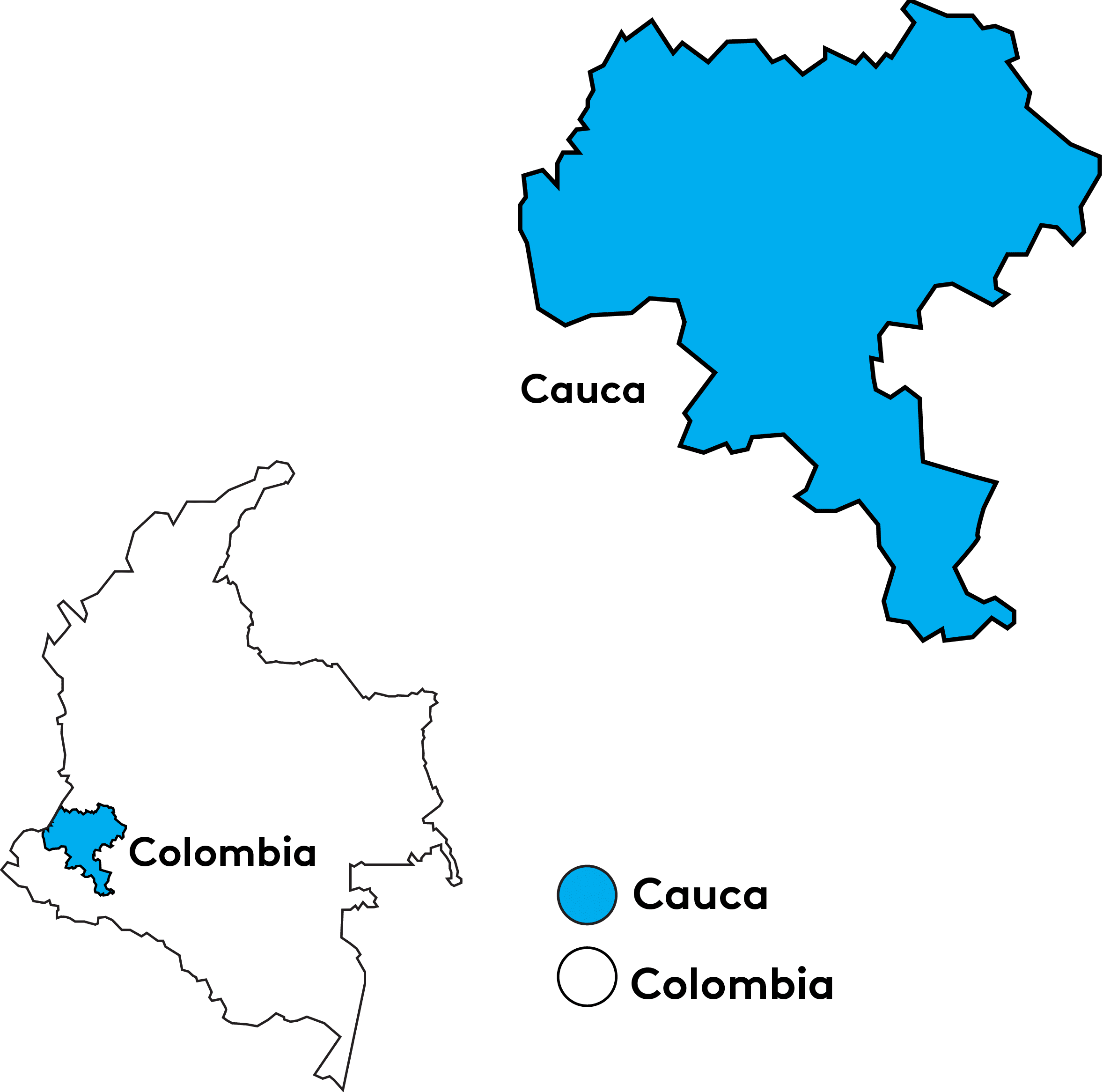
Finca El Paraíso is a family-owned coffee project located in Los Arados, Tunía, in the municipality of Piendamó, Cauca, along the Pan-American Highway between Popayán and Cali. The farm is led by Diego Samuel Bermúdez Tapia, co-founder and manager of INDESTEC SAS, a family company dedicated to the production, processing, and commercialization of high-quality specialty coffees.
Diego’s journey in coffee began over twelve years ago. With a background in Agricultural Business Administration, he found in coffee not only a profession but an opportunity to build a company around innovation, knowledge, and family. In 2015, Finca El Paraíso placed 16th in a regional coffee quality competition, marking an important turning point for the project and opening the door to a deeper exploration of specialty coffee and differentiated processing.
Located at 1,930 meters above sea level, Finca El Paraíso benefits from a temperate and humid climate, as well as the influence of Pacific winds. These conditions contribute to a slow cherry maturation, allowing for greater sugar concentration and supporting the development of complex and expressive cup profiles. At El Paraíso, every stage of production is carefully managed, from cultivation and nutrition plans to fermentation, drying, and final preparation.
This Lychee Peach profile begins with the careful selection of ripe cherries, laying the foundation for a balanced cup with depth and complexity. The cherries are ozone-disinfected and undergo 36 hours of anaerobic fermentation submerged in water, followed by pulping and demucilagination. The pulp and mucilage are then used to cultivate specific microorganisms, generating aromatic and flavor precursors that are reintroduced into the tanks for a further 12 hours under controlled pressure, allowing them to bind directly to the beans.
A thermal shock wash helps preserve the aromatic compounds, after which the beans are gently dried using a dehumidification system. This ensures uniform moisture removal while minimizing oxidation and the risk of unwanted fermentation. The coffee is then stabilized, stored under cool conditions, and carefully milled in accordance with strict quality standards.
The coffee is subsequently sent to Descafecol, where it undergoes decaffeination using the sugarcane-derived ethyl acetate (EA) process. Once decaffeinated, the coffee is prepared for shipment, preserving its distinctive character throughout the final stages of processing.
The result is a coffee with a remarkable fruit-forward profile, expressive lychee and peach notes, and a refined balance of sweetness and complexity.